Why should you know about the tools you use for your SEO work?
Sometimes I assume that everybody I work with comes from the same background as mine: front-end web design with coding expertise, all mixed up with roughly 10 years of digital marketing experience.
Clearly I’m wrong; and making the wrong assumptions can cost quite a lot of time when it comes to verifying how the job you delegated has been done.
Today I’d like to point out something that, as an SEO, you probably use quite often: the Inspect Element feature of your browser.
Depending on the browser you are using, the name of the product changes: for example, Firefox comes with Firebug, Safari with WebKit’s web inspector, Opera with Dragonfly, Chrome with (ehmm) Chrome Developer Tools. Regardless of the name, Inspect Element will let you see the DOM of your page as the browser sees it.
That’s where this tool can actually cause you problems, or at least a bit of confusion.
When you choose “Inspect Element”, or otherwise bring up your browser’s DOM inspector, what you’re looking at is the document tree after the browser has applied its error correction and after any JavaScript has manipulated the DOM (all depending on the specific quirks and feature support). So, in a few words, Inspect Element doesn’t necessarily show the same thing you see when you choose “View Source”, which is exactly what the server returns.
Apparently there is nothing that SEOers or web developers can do to get the full source code other than using the “View Source” panel of your browser.
Of course this is not the only “problem” you may face. For example, View Source in Chrome sends another request to retrieve the URL again; in the majority of circumstances this is fine, but there could be a case where a website requires authentication, and since Chrome’s request isn’t authenticated you may be returned the source of the login page.
Different story for Internet Explorer, where the source code shown is that of the page cached a few moments earlier.
I could keep going with differences for another chapter or two at the very least, but this is not the reason I wrote this post — although it is a shame there isn’t a “switch mode” that quickly shows the “unrendered” portion of the code in a simple snap.
This is all nice, but...
Why should I know how my tools work?
Well, I would expect a professional to be able to use their own toolkit, regardless of the industry they work in, because that way tasks can be completed more quickly and efficiently. Simple as that.
This is clearly not a complaint about those juniors who are learning the foundations of the job, but more a warning to those professionals who treat – in the SEO case – the findings of their work very superficially, without digging around when this is ideally required.
Cool ... but why are you telling me this? I’m a pro after all.
I wasn’t doubting this in any way; however, a couple of days ago, I was involved in a conversation where, apparently, we were facing one of those cases of “link selling” that Penguin should have been able to detect straight away, but didn’t.
According to the accuser, the link was passing juice, and this was totally unfair and didn’t respect the guidelines.
I had a look at both sites, then I replied to the author of the thread, saying that IMHO there was nothing wrong, and that although borderline, the case was OK. I’ll let you imagine the reactions (and the insults) I received over the following minutes from all the participants.
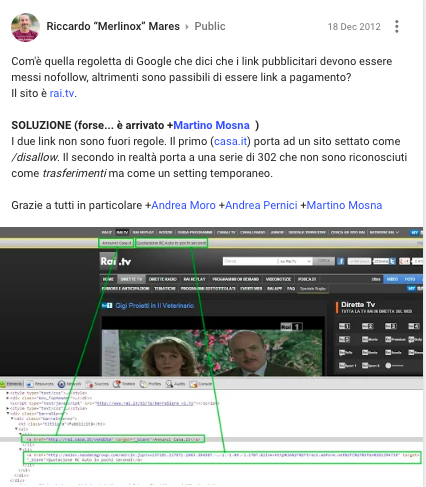
To help you understand, here’s the scenario: the website is that of the national Italian television broadcaster, Rai.it, accused of selling links by placing two links underneath the main navigation bar, as shown in the picture below.
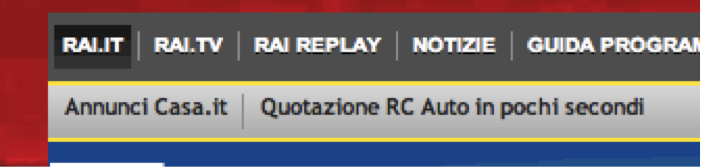 As a matter of fact, Rai declares those links to be promotional ads - as stated on the right-hand side of the bar - so in theory there is nothing wrong with this. And in fact the nature of the conversation suddenly moved to the technical SEO implementation and the infringements of the SEO guidelines.
What does Google say regarding paid links?
We all know what the webmasters’ guidelines say regarding promotional links, don’t we? As a refresher, Google says it is prohibited to buy or sell links that pass PageRank. This includes:
- exchanging money for links,
- posts that contain links
- exchanging goods or services for links
- sending someone a “free” product in exchange for them writing a review
- including a link where it is not allowed (or clearly inappropriate)
On the same page, Google also makes provision for people involved in “content marketing” activities, saying a link can be passed this way provided it doesn’t pass PageRank — which you can prevent with several methods, such as:
- Adding a rel="nofollow" attribute to the
<a>tag - Redirecting the links to an intermediate page that is blocked from search engines with a robots.txt file
Now that the scenario is a bit clearer, let’s analyse the whole diatribe together.
The first claim: this is a direct link
That’s the main reason I wrote this article. I’m quite confident an inaccurate initial check was done, without considering that both links are part of a Display network and are therefore generated via JavaScript (no direct link at all). However, having a look at the code with Inspect Element, at first sight they appear to be just that.
On top of this, despite Google’s capacity to analyse JavaScript code, during my previous tests I have never been able to demonstrate to myself that juice is passed via these links.
The second claim: the nofollow attribute is missing
Ok, this is true. And apparently the links are not respecting the guidelines.
Again, the links are the result of JavaScript code, and in theory there is no real necessity to append the nofollow attribute, though including it would probably make Rai.it more compliant with the guidelines.
In their defence, it must be said Rai has very little (if any) control over the code output, and the Display provider is the only company responsible for this.
The third claim: perhaps the disallow in the robots.txt will bring the targeted site in line with the webmaster guidelines
After I came back saying that I wasn’t able to assign responsibility, inviting people to have a better look at the site, those involved in the conversation finally started digging around a bit more, and the fact that the targeted site was entirely disallowed via robots.txt was mentioned.
Now, here’s another big problem: people don’t read, or at least do so superficially!
Google’s Webmasters’ guidelines mention the nofollow or the intermediate robots.txt file as ways of making a site compliant, but again this is not an exhaustive list.
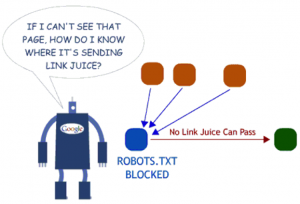
In this particular case, although it is the targeted site that contains the robots.txt with the disallow directive, if you think about this scenario holistically, you will suddenly understand that there should be no capacity for the link to pass PageRank.
Those who took part in the discussion were saying the opposite; however, none of them brought in any real example to confirm their statement (nor did I), but I bet the image above (found on SEOmoz) explains the concept very well.
The fourth claim: all URLs contain a canonical tag as well as a 301 redirect
Although this is true, I believe the destination website, casa.it, implemented both the canonical and the redirect prior to activating the advertising.
Again, robots.txt prevents Google from accessing the site, and the files already indexed are in theory useless for the sake of their backlink profile — rather more a precaution to avoid problems due to canonicalisation.
In conclusion...
The Webmaster’s guidelines provided by Google offer a clear vision of what paid links are and some straightforward (though not complete) suggestions for their implementation. In my opinion, something that should be made clear is how links between “properties” or “partnered” websites should be created.
In fact, by doing some research on the Internet, it appears that rai.it and casa.it partnered the two sites back in 2009.
From an investigative point of view, however, I would like the people involved in the conversation to be more cautious before pointing fingers, and to try to understand that sites are not all the same and that search engine algorithms attempt to solve problems as a whole, scaling them down, rather than individually.
As usual, this article represents my point of view. I am not associated with Google or Rai, and this has been written purely to technically dissect and bring to the table the answers to the "questions" that emerged during the G+ conversation.